
A Golang CMS is a content management system whose server-side runtime is written in Go. GoPress is an open-source, self-hosted Golang CMS framework designed for teams that want familiar publishing workflows—posts, pages, media, themes, plugins, taxonomies, and an admin interface—inside a Go application and deployment model.
GoPress is not a line-by-line WordPress rewrite and it is not a claim that every website should move away from PHP or JavaScript. It addresses a more specific need: developers may want a practical CMS without operating a separate application stack or giving up Go’s compiled deployment, concurrency model, static typing, and standard tooling.
This guide explains what a Go-based CMS is, why GoPress uses Go for its runtime, what the framework includes, where it fits, and when another type of CMS may be the better choice.
What Is a Golang CMS?
A Golang CMS—also called a Go CMS or a CMS written in Go—uses Go for the backend that stores content, serves pages or APIs, runs administrative workflows, processes media, and coordinates background work. The frontend can still use server-rendered templates, a JavaScript framework, a mobile application, or several delivery channels.
The programming language alone does not define whether a CMS is traditional or headless. A Golang CMS can support three delivery models:
- Traditional: the CMS manages content and renders the public website with themes.
- Headless: editors manage content in the CMS while external applications consume it through APIs.
- Hybrid: the same installation renders a website and exposes content APIs for other clients.
GoPress follows the hybrid model. It includes a theme runtime for server-rendered sites and REST endpoints for applications that need structured content delivery. That makes it useful for company websites, documentation hubs, editorial sites, product catalogs, and custom Go applications that need an integrated publishing layer.
Architecture At A Glance
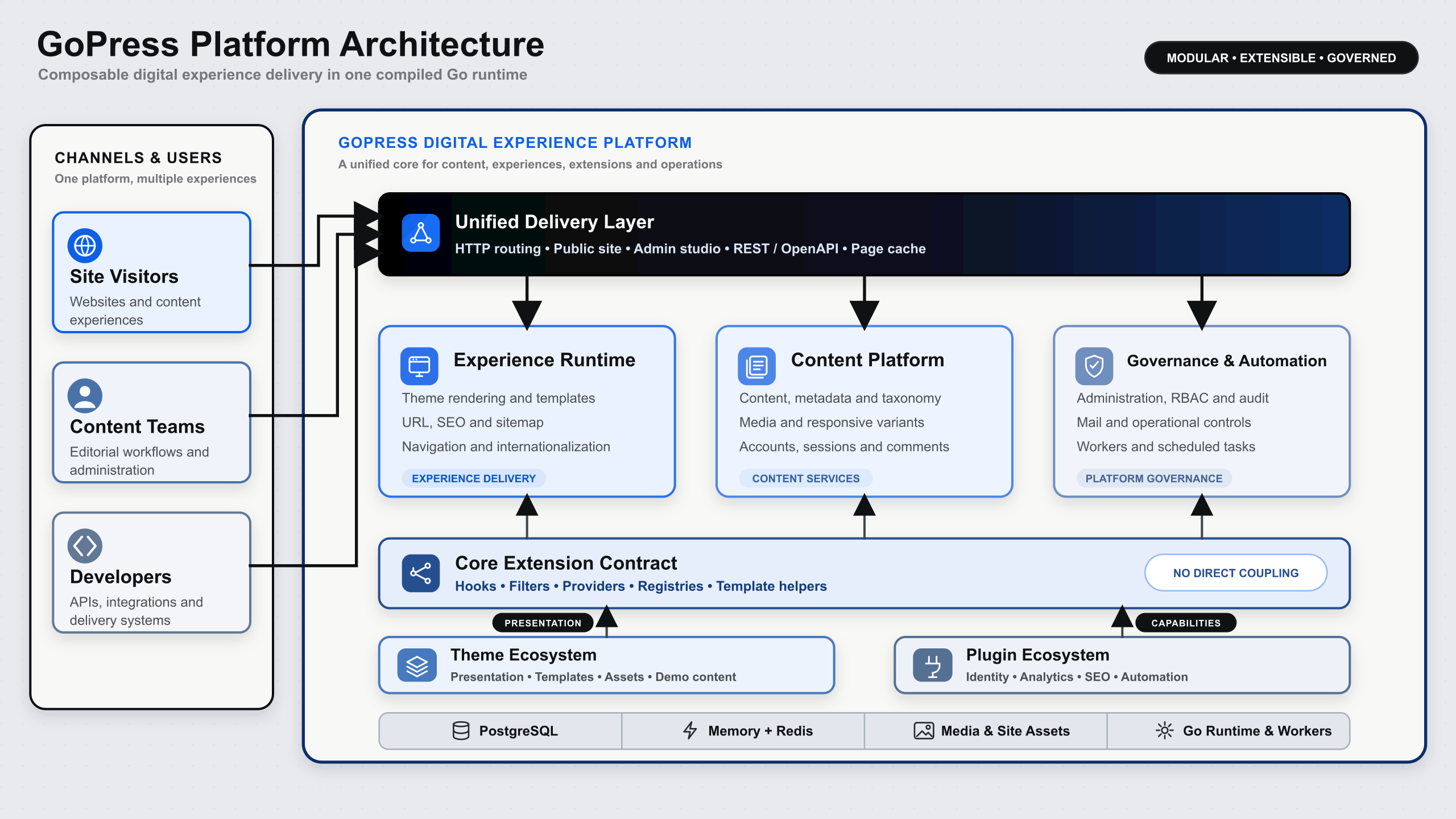
GoPress brings public delivery, admin workflows, REST / OpenAPI, content services, and governance into one compiled Go runtime. Themes contribute presentation and plugins contribute capabilities through the generic core extension contract rather than direct runtime coupling, while PostgreSQL, optional Redis, media assets, workers, and scheduling form the runtime foundation.
Why Build a CMS Runtime in Go?
The familiar CMS model remains useful. Editors understand posts, pages, media libraries, categories, menus, and scheduled publishing. Developers understand themes, plugins, custom content types, and extension hooks. The opportunity is not to discard that model, but to implement it with a runtime that fits Go-based infrastructure.
A compiled deployment artifact
Go applications can be built as a compiled service. In GoPress, the selected themes and plugins are included at build time, while site configuration and content remain outside the binary. A deployment can therefore consist of the GoPress service, PostgreSQL, site configuration, uploads, and optional Redis caching.
This does not eliminate operational work—you still need TLS, backups, monitoring, database maintenance, and a safe release process—but it can reduce the number of language runtimes and package managers in a Go-centered environment.
Long-running process capabilities
A Go CMS runs as a long-lived service rather than rebuilding the application state for each request. That model works naturally with in-memory registries, connection pools, cache layers, scheduled tasks, and worker pools.
GoPress uses this runtime shape for content-type registration, theme and plugin hooks, L1 memory caching, optional Redis caching, page caching, cron-style scheduling, and background workers. These are framework capabilities, not a promise that every GoPress website will be fast automatically. Template design, database indexes, image weight, network latency, and cache configuration still matter.
Typed extensions and explicit boundaries
Dynamic plugin ecosystems are flexible, but they can make dependency relationships difficult to trace. GoPress favors Go interfaces, registered hooks, filters, and explicit framework contracts. Themes render the presentation layer; the engine owns shared concerns such as routing, queries, SEO, media, and administration; plugins connect through defined extension points.
This design requires Go development and usually a rebuild when code-level extensions change. The trade-off is stronger compile-time checking and a clearer path for testing, code review, and long-term maintenance.
One language across the application layer
For a team already building APIs and services in Go, a Golang CMS can keep content management closer to the rest of the application. Engineers can reuse familiar logging, testing, profiling, deployment, and observability practices instead of maintaining a separate CMS technology stack.
What Does the GoPress Golang CMS Include?
GoPress combines the core pieces required for content management instead of providing only a database wrapper or content API.
| CapabilityWhat GoPress provides | |
| Content model | A unified content and metadata model for posts and theme-declared custom content types |
| Admin CMS | Role-aware content lists, editing, filtering, pagination, media selection, and rich-text authoring |
| Themes | Config-driven content types, routes, templates, menus, settings, and reusable template helpers |
| Plugins | Go interfaces plus action and filter hooks with defined activation and deactivation behavior |
| APIs | REST endpoints for registered content types with Swagger/OpenAPI documentation |
| SEO | Permalinks, canonical URLs, meta descriptions, Open Graph data, JSON-LD, sitemaps, and redirects |
| Media | Upload management, alt text, responsive image variants, and WebP/JPG/PNG output |
| Caching | In-memory cache, optional Redis, and page-cache middleware with graceful fallback |
| Multilingual content | Language-prefixed routes, translated content and menus, and sitemap hreflang support through the multilang plugin |
| Background work | A goroutine worker pool and cron-style scheduler |
| Access control | Admin, editor, author, and subscriber roles for the administration area |
| Multi-site operation | Site-level configuration and table prefixes for isolated instances sharing infrastructure |
The framework also ships with example themes and bundled plugins for multilingual publishing, per-content SEO fields, code snippets, and first-party analytics. See the GoPress modules overview for the main building blocks.
How the GoPress Architecture Works
GoPress separates the CMS into a few explicit layers:
- The engine starts configuration, database access, caching, queues, content services, routing, the admin application, and the active theme.
- The content registry defines posts and any custom content types declared by a theme, including their routes, supported fields, taxonomies, and API behavior.
- Themes control public rendering while using shared framework helpers for URLs, menus, translations, responsive images, and SEO output.
- Plugins extend the system through actions, filters, admin fields, routes, sitemap transformers, and other documented contracts.
- The delivery layer can render HTML through themes, expose structured content through REST APIs, or do both.
This separation is intended to prevent a theme from becoming a second CMS engine and to prevent plugins from depending directly on a particular theme. For a deeper technical view, read the GoPress architecture overview and content-first architecture guide.
Golang CMS vs WordPress, Headless CMS, and Static Site Generators
Choosing a CMS is mostly about workflow and operational fit. The implementation language matters, but it should not be the only decision.
| OptionBest fitMain trade-off | ||
| GoPress / Golang CMS | Go teams that need a self-hosted admin, themes, APIs, and extensible content models | Smaller ecosystem and a beta project that requires technical evaluation |
| WordPress | Teams that prioritize a mature plugin/theme ecosystem and broad editor familiarity | A different runtime and maintenance model from a Go application stack |
| Headless SaaS CMS | Teams that want managed editorial infrastructure and API delivery | Ongoing service dependency, pricing, and less control over the CMS runtime |
| Static site generator | Documentation or marketing sites with Git-based publishing and infrequent dynamic workflows | Usually lacks a full browser-based editorial workflow unless additional services are added |
| Custom admin application | Products with highly specialized domain workflows | Highest development and maintenance cost for standard CMS capabilities |
GoPress is most compelling when the requirement is not simply “serve Markdown quickly.” It is for projects that need non-developers to manage content, media, menus, SEO fields, and publishing states while developers retain control of a Go-native application.
When Is GoPress a Good Fit?
A GoPress installation may be a good fit when:
- your backend team already works primarily in Go;
- you want a self-hosted CMS rather than a hosted content service;
- editors need a browser-based admin instead of a Git-only workflow;
- the project needs custom content types, taxonomies, themes, or plugins;
- you need both server-rendered pages and REST content delivery;
- SEO metadata, sitemaps, redirects, and responsive media should be part of the framework;
- you prefer compiled, reviewed extensions over runtime-installed code;
- you are comfortable validating a beta project for your own production requirements.
Typical use cases include company websites, content-rich product sites, documentation portals, internal publishing tools, focused editorial properties, and Go applications that need a CMS module alongside product-specific features. More examples are available on the GoPress use cases page.
When Should You Choose Something Else?
GoPress is not the automatic answer for every project. A mature CMS may be better if your team depends on a large marketplace of ready-made plugins, page builders, ecommerce integrations, or agencies. A managed headless CMS may be better if you do not want to operate the database, uploads, backups, and application service. A static site generator may be simpler if every contributor is comfortable with Git and the site does not need dynamic editorial workflows.
Project status matters too. GoPress is currently in beta. Its content model, admin CMS, theme engine, plugin system, SEO layer, cache path, media pipeline, and example themes are usable, but the project still needs broader production validation, public benchmark coverage, migration guides, and additional security review before a stable release.
For production adoption, begin with a company site, documentation portal, internal tool, or another bounded workload. Test your editorial workflow, access-control requirements, traffic profile, backup and restore procedure, media volume, upgrade path, and monitoring before committing a critical property.
How to Evaluate a Golang CMS
Do not evaluate a CMS only by a homepage benchmark. Use a practical checklist:
- Editorial workflow: Can non-developers create, review, schedule, update, and organize the content they own?
- Content modeling: Can the system represent your products, services, documentation, authors, categories, and relationships without forcing everything into a generic page?
- Extension model: Are custom features testable, maintainable, and isolated from theme presentation?
- SEO control: Can each page produce a stable URL, canonical tag, useful metadata, structured data, sitemap entry, and redirects?
- Media handling: Are images stored safely, given alt text, and rendered in responsive formats and sizes?
- API delivery: Can other applications consume published content with clear documentation and access rules?
- Operations: Are configuration, logs, backups, health checks, caching, and deployments understandable to your team?
- Security and maturity: Is the project’s release status appropriate for the risk level of your site?
These questions expose the difference between a Go content library, a headless API, and a complete Golang CMS.
Getting Started with GoPress
GoPress requires Go 1.25 or later and PostgreSQL 14 or later. Redis is optional; when it is unavailable, the framework can fall back to memory-only caching. After cloning the repository, you can build the GoPress CLI and start the web installer:
git clone https://github.com/0xmattg/go-press.git
cd go-press
go mod download
make gopress
./build/gopress serve
The first run opens an installer for the database connection, site settings, and administrator account. Once started, the public site, admin CMS, Swagger documentation, and REST API are available from the same GoPress application.
Read the GoPress documentation before deploying, especially the installation, configuration, theme, plugin, backup, and production-operation guidance.
Frequently Asked Questions About Golang CMS Platforms
Is GoPress written entirely in Go?
The server-side CMS engine, admin services, content layer, theme runtime, plugin system, APIs, caching, and background workers are implemented in Go. Public themes still use HTML templates, CSS, and JavaScript where appropriate, and the rich-text editor runs in the browser.
Is GoPress a headless Golang CMS?
GoPress can operate as a headless or hybrid CMS because registered content types can expose REST endpoints. It also includes a server-rendered theme system, so a separate frontend application is not required.
Can GoPress replace WordPress?
It can cover many core workflows—content editing, media, themes, plugins, custom content types, SEO, menus, and APIs—but it does not have WordPress’s decades-old extension ecosystem. The right choice depends on required integrations, editorial expectations, the team’s Go experience, and the project’s tolerance for beta software.
Which database does GoPress use?
The current GoPress setup targets PostgreSQL 14 or later. Redis is optional and is used as an additional cache layer rather than the primary content database.
Does GoPress support SEO?
Yes. The core includes URL rewriting, canonical links, metadata, Open Graph output, JSON-LD, sitemaps, and redirects. The bundled SEO plugin adds per-content title, description, image, and robots overrides. Final SEO quality still depends on the theme and the content entered by the site team.
Does GoPress support multilingual websites?
Yes. The multilang plugin supports translated content, menus, and site settings, language-prefixed URLs, language-aware routing, and hreflang alternates in sitemaps.
Is GoPress open source?
Yes. GoPress is released under the MIT License. Review the repository, project status, and documentation before selecting it for a production workload.
A Familiar CMS Model on a Go Runtime
The reason to build a Golang CMS is not that older CMS ideas stopped working. It is that some teams want those proven editorial concepts in an application that matches their Go infrastructure and engineering practices.
GoPress keeps the useful parts of a conventional CMS—an admin interface, content models, themes, plugins, media, SEO, and publishing workflows—while using Go for the runtime, extension contracts, APIs, caching, and deployment. If that combination matches your project, explore the GoPress architecture, review the modules, and try the framework in a bounded environment before planning a larger migration.

Sign in or register with an available identity provider to join this discussion.